
There has never been more information available about a dairy or beef herd than there is right now. Activity collars, rumination sensors, in-line milk meters, automated body condition scoring, parlor software, feed management systems, lab results, treatment logs. A single client operation can generate thousands of data points a day.
And yet, in most bovine practices, the conversation on the herd visit still starts the same way it did fifteen years ago: what's going on since I was last here?
That gap — between data volume and data usefulness — is one of the most under-discussed problems in bovine practice today. It's also one of the reasons herd data insights and monitoring technology remain a recurring theme at AABP. Dr. Luis Mendonca is presenting on monitoring technology and herd data insights at this year's Annual Conference, and it's a session worth putting on your schedule if you spend any part of your week trying to turn client records into recommendations.
Because the hard part isn't collecting the data. It's the recordkeeping layer underneath it.
The problem isn't data. It's data that doesn't connect.
Most practices aren't short on information. They're short on information that lives in one place, in a consistent format, tied to the right animal, at the right time.
The typical picture looks something like this:
- Treatment records live in the client's on-farm software
- Your exam findings live in your own notes, or in a chart note written from memory that evening
- Lab results arrive by email and get filed in a folder
- Protocol changes are agreed on verbally during a herd visit
- Monitoring system alerts are reviewed by the herd manager, not the veterinarian
Each of those sources is accurate on its own. Together, they don't add up to a picture. So when you sit down to answer a question that should be simple — is the metritis protocol working?, did fresh cow treatments actually go down after we changed the transition ration? — the answer requires reconstruction work rather than a lookup.
Reconstruction work is the tax bovine practices pay on bad recordkeeping. And it gets paid in the most expensive currency you have: veterinarian hours.
What good herd recordkeeping actually has to do
It's easy to describe good recordkeeping as "complete." Complete isn't the standard. Usable is the standard. In practice, that means four things:
1. One animal, one history.
Every event — exam, treatment, diagnosis, culling decision, monitoring flag — attached to the same animal identity across every visit and every year. If an ID has to be matched by hand between systems, the history will eventually break.
2. Consistent language.
Ten veterinarians describing the same condition ten ways makes a dataset that can't be counted. Standardized diagnosis and protocol terminology is unglamorous, and it's the single highest-leverage recordkeeping decision a practice can make.
3. Records that capture the decision, not just the event.
Knowing a cow was treated tells you what happened. Knowing why the protocol was chosen, and what threshold triggered it, tells you whether the protocol is working. The second one is what enables herd-level analysis.
4. Time-stamped continuity.
Herd health is a trend business. A record system that shows you today without showing you the last twelve months can't support the conversations that clients actually pay for.
Monitoring technology raises the stakes on both sides
Here's what makes this urgent rather than merely annoying: monitoring technology increases the value of good records and the cost of bad ones at the same time.
When sensor data is layered on top of clean, consistent herd records, it becomes genuinely diagnostic. You can see whether rumination drops preceded clinical cases, whether a transition protocol change moved the curve, whether an intervention held three months later. That's the kind of insight that changes a veterinarian's role from responder to advisor.
When sensor data is layered on top of fragmented records, it mostly generates alerts. High volume, low context, and no way to close the loop between what the system flagged and what was actually done about it. Producers get alert fatigue, veterinarians get pulled into interpretation without the history to interpret against, and the technology's value stalls out.
The technology didn't fail in the second scenario. The recordkeeping did.
Where practices tend to get stuck
A few patterns show up repeatedly:
- The data lives on the farm, not in the practice. Insight depends on client software access, so analysis only happens when someone remembers to pull a report.
- Herd-level work is done in spreadsheets. It works, it's fragile, and it lives on one person's laptop.
- Documentation happens after hours. Records written at 9pm from memory are less specific than records captured in the moment, and specificity is exactly what herd-level analysis needs.
- No one owns the data standard. Without a defined protocol and diagnosis vocabulary, drift is guaranteed.
None of these are knowledge problems. Every veterinarian reading this already knows what good records look like. They're workflow problems — and workflow problems get solved with systems, not with resolve.
The practical starting point
If you want herd data to be an asset in 2026 rather than a growing backlog, three moves do most of the work:
- Standardize your diagnosis and protocol terminology across the practice, and write it down. This costs one meeting and pays out indefinitely.
- Capture records at the point of care, on the farm, not from memory later.
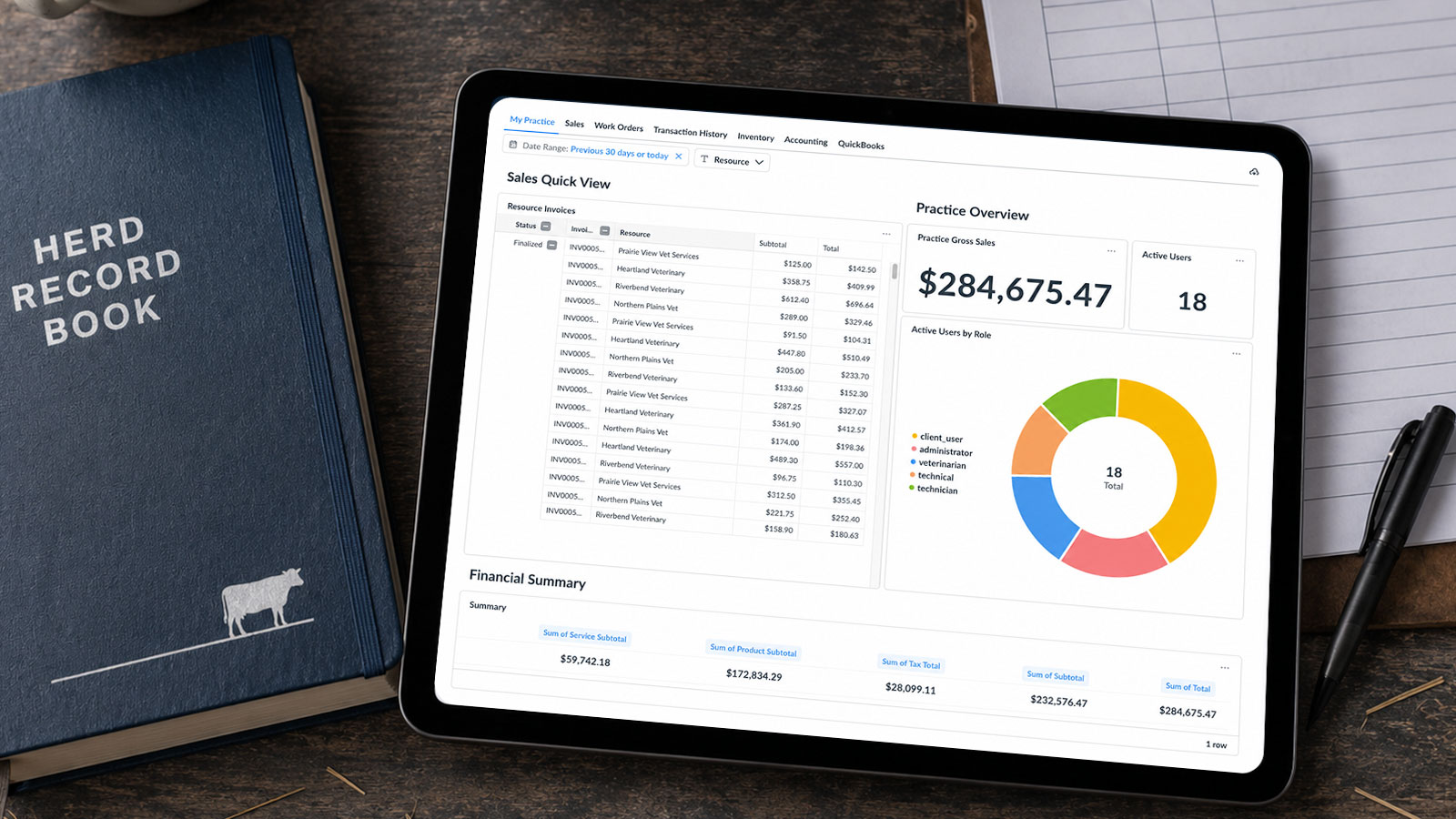
- Put herd history and monitoring context in the same place your veterinarians already work, so trend analysis is a normal part of a herd visit rather than a special project.
That last one is what practice management software is supposed to do — and where general-purpose veterinary systems built for companion animal practice tend to fall apart. Herd-level thinking requires herd-level structure: animals in groups, protocols applied at scale, trends over months, records that belong to an operation and not just to a patient.
See What Your Herd Data Could Be Telling You
VetLogix is built specifically for bovine practice, which means herd data, group-level protocols, and production recordkeeping aren't add-ons — they're the design center.
The fastest way to know whether it fits your practice is to bring us a real problem. Pick the herd-level question that currently takes you an hour of reconstruction to answer, and we'll walk you through answering it in a 20-minute demo.
Already heading to Minneapolis? Catch Dr. Luis Mendonca's session on Improving Efficiency Through Monitoring Technology and Data Insights, then find us at Booth #528 — tradeshow floor open August 27–28, Minneapolis Convention Center.